Anthropic, Google and Meta all shipped in three days: a working reading of the first week of September 2026
Claude Fable 5.1 on 1 September, Gemini 3.8 Flash on 2 September, Muse Spark 1.3 on 2 September. What each one actually changed for a UK service business.
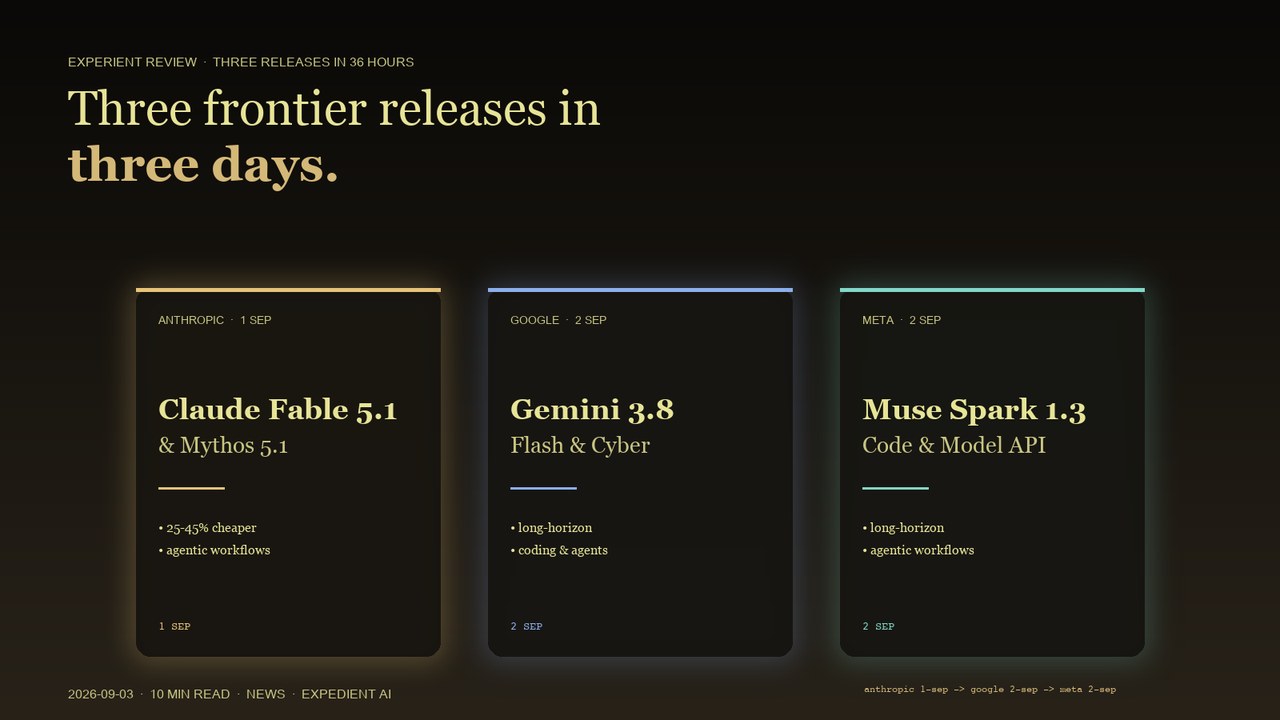
Between 1 and 3 September 2026 the three big American frontier labs all shipped a new model within roughly thirty-six hours of each other. Anthropic released Claude Fable 5.1 and Claude Mythos 5.1 on 1 September. Google released Gemini 3.8 Flash on 2 September, with a gated Gemini 3.8 Flash Cyber variant for vetted defenders. Meta released Muse Spark 1.3 on 2 September, rolling out in Muse Code and the Meta Model API. This is a working reading of what each one actually shipped, and what it means for a UK service business running AI in production.
What Anthropic actually shipped
Claude Fable 5.1 and Claude Mythos 5.1 are the same model with two different safeguard levels. Fable 5.1 is generally available. Mythos 5.1 is gated through Anthropic's trusted access programmes and is positioned for cybersecurity and life-sciences work where the additional safeguards make sense. If you are a normal UK service business, the one you will touch is Fable 5.1.
The headline change for operators is price, not capability. Anthropic cut cache read pricing, which is where the bill lives on any agentic workflow that re-reads the same tool outputs, file contents or conversation history multiple times. Anthropic's own framing is roughly 25% cheaper for typical workloads and up to 45% cheaper for highly agentic workflows. For a small business running long context windows with code editors, document Q&A or multi-step research, that is the line item that matters.
Data retention gets a proper enterprise answer. Anthropic's new Enterprise Frontier Safeguards (EFS) keep customer data inside cloud infrastructure the customer controls, while still giving Anthropic the signal it needs for safety monitoring. EFS rolls out in phases from late autumn 2026. Until then, eligible customers can use Fable 5.1 under zero data retention. For any UK business in financial services, legal or healthcare, the data retention story is the thing that was previously the reason not to use Claude in production. That barrier has now been answered on paper.
Capability lifts are concentrated on long-horizon work and code. Anthropic's benchmarks for Fable 5.1 emphasise Terminal-Bench, agentic scientific research, multidisciplinary reasoning and agentic coding, where the gap to Fable 5 widens as the task gets longer. The model's default effort level is High inside Claude Code and Medium inside Claude Cowork and Claude.ai, which means you do not have to do anything to get the lift. If you were already paying for Fable 5 in your coding workflow, you should see the difference without changing anything.
The Mythos 5.1 angle is mostly for the security crowd. Mythos 5.1 is the gated build with safeguards tuned for cyber and biology work. Anthropic also fixed a specific false-positive problem: cyber safeguards now block 60% fewer benign queries than before, and Fable 5.1 can be used to discover software vulnerabilities (though not to develop exploits for them). If you are running a security consultancy or red team, Mythos is the one to ask for access to. If you are not, ignore it.
What Google actually shipped
Gemini 3.8 Flash is the third Flash release in six weeks. Google has been running a tight release cadence on the Flash line, and 3.8 Flash is positioned as their best reasoning and coding model yet, at the same introductory price as 3.7 Flash: $0.75 per million input tokens and $3.75 per million output tokens. That introductory price expires on 31 December 2026, at which point list pricing steps up to $1.50 and $7.50. For a small business planning spend into 2027, that step-up matters and is the most easily missed line in the announcement.
It is a long-horizon coding and agent model. Google explicitly says 3.8 Flash "works harder" on complex tasks, executing extra reasoning steps and calling tools iteratively rather than going for raw tokens-per-answer efficiency. On the long-horizon software engineering benchmark DeepSWE v1.1, 3.8 Flash reportedly outperforms larger frontier models end-to-end. On HLE-Verified it hits 54.9%. The honest read is that Flash has moved from "good enough for the cheap layer" to "strong enough for the middle of the stack, including serious agent work."
Gemini 3.8 Flash Cyber is the gated security variant. It uses the same underlying intelligence as the regular Flash, but is exposed through Google's new Fairwind programme to a vetted set of defenders. If you are a UK MSSP, blue team or critical infrastructure operator, this is the one to apply for. Same caveats as Mythos 5.1: do not bother applying if you are not in that pool.
The practical shift for a UK business already on Google Workspace is that the model switched on you. If you are paying for Workspace and using Gemini for email triage, document summarisation or sheets work, 3.8 Flash is what arrives automatically behind the scenes. You do not need to deploy anything. The lift you will see over the next two to four weeks is in long-document reasoning and tool use, which is exactly where the Workspace integrations spend most of their time.
What Meta actually shipped
Muse Spark 1.3 is a Meta Superintelligence Labs update focused on agentic workflows and coding. It rolls out on 2 September 2026 in Muse Code and the Meta Model API. Meta positions it as drawing on what they learned from months of broad adoption of Muse Code and the Meta Model API. Previously available reasoning modes are in from launch; the higher reasoning effort setting is "coming shortly after additional safety testing."
The agentic framing matters more than the benchmark. Muse Spark 1.3 is tuned for longer-horizon work in a single thread, asking clarifying questions when prompts are ambiguous, and confirming before taking consequential actions. Meta highlights three things: better preservation of detailed requirements in long tasks, more accurate routing of incoming prompts to the right task in messy multi-threaded contexts, and a better sense of the model's own capability boundaries (less hallucination when it hits a wall). If you have used Muse Spark 1.1 in production you will recognise the failure modes those three things are aimed at.
Source caveat. Meta's main AI blog at ai.meta.com/blog still lists Muse Spark 1.1 (from July) as the most recent Muse Spark post. The Muse Spark 1.3 announcement is on Meta's research subdomain at research.meta.ai/blog/introducing-muse-spark-1-3, not on the main blog. This is worth knowing because it is where to look for future Muse Spark drops, and because the absence of a parallel press release on the main blog is, for now, a small but real signal that this is a developer-focused release rather than a headline-grabbing one.
For a UK service business the read is straightforward. Muse Spark 1.3 is the new default if you were already on Muse Spark 1.1, and it does not change the broader answer to whether to run Meta models. If you were not on Meta models before, there is nothing in 1.3 that should pull you in. Meta is still going after the developer and personal-agent layer, not the enterprise compliance layer.
What actually changed for a UK service business
Three shifts. None of them are about a single model. They are about the operating economics of running AI in September 2026.
1. The cheap layer got both cheaper and more capable at the same time. Anthropic cut cache pricing, which is the line that matters most for agentic workflows. Google's 3.8 Flash is positioned as the best Flash yet at the same introductory price. Meta's Muse Spark 1.3 is an iteration on the agentic workflow the previous model already had. Net effect: the tier of work your business does most of (drafting, summarising, classification, triage, long-document reasoning) is now either cheaper, more capable, or both.
2. The frontier layer got two answers to the same question. Anthropic and Meta both shipped a "long-horizon agentic model that knows its limits" in the same week. Google shipped a coding-and-reasoning workhorse that is positioned as good enough for the middle of the stack. The frontier is no longer "one big model that does everything slightly better." It is "two or three specialised models that each do one thing very well, with a cheap layer underneath that can do most of what the frontier used to do." The Mercury OS install shape already routes by task; the news this week is that there are more routing choices and the cheap layer is now genuinely good enough for more of the work.
3. The compliance and data story got a proper answer on Anthropic. Enterprise Frontier Safeguards, paired with zero data retention until EFS rolls out, is the answer to the question UK regulated businesses have been asking for eighteen months. If you are in financial services, legal or healthcare, and you have been waiting for Claude to be deployable under your data-handling rules, this is the week that answer arrived. It is not the same as a UK-specific certification, but it is a serious step.
What to do on Monday
If you are running AI in your business today, the boring thing is the right thing.
Re-price your Anthropic bill. If you are on Fable 5 with significant agentic workflow volume, the 25%-to-45% cache read cut translates directly into a smaller bill. Recalculate against last month's actual usage. If the saving is meaningful, raise the work you route to Claude.
Test Gemini 3.8 Flash against your top ten prompts. If you have a Google Workspace spend, you will get 3.8 Flash automatically behind the scenes. The honest test is the same one we have been recommending for months: take your ten most common prompts, run them on the new model against the old, and see whether the lift is real on your work, not on the leaderboard.
Wait on Muse Spark 1.3 unless you are already in Meta. There is no UK enterprise compliance story for Meta yet. If you are using Muse Spark 1.1 in production, the 1.3 update is a free lift. If you are not, this is not the week to switch providers.
Do not chase the headlines. Three frontier releases in three days is the kind of week that makes operators want to redo their stack. Resist the urge. The wins available this week are in the line items (cache pricing, default Flash model behind Workspace, agentic reliability on Muse Spark), not in reshuffling which provider you pay.
The honest version
If you are not in the AI business and you are a UK service business owner, the short version is this. The AI you are paying for just got either cheaper or more capable on Tuesday, Wednesday and Thursday this week, depending on which provider sits behind the tool you use. If your vendor is on top of their game you will see the lift in the next two to four weeks. If you do not, that is the signal to ask them.
If you are running AI yourself, do the boring thing. Run your top ten prompts against the new models that touch your work. Change one thing. Leave the rest. This was not a breakthrough week. It was a week where the cheap layer got cheaper, the frontier layer got specialised, and the compliance story got a proper answer for the customers who needed one. That is good news for the economics of running AI in a small business, and not much else.
